Amazon Kindle, Magazines Could be the Killer App
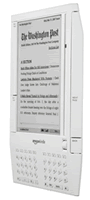
Electronic readers hold incredible promise, particularly for the environment: replacing paper books with electronic downloads could reduce paper consumption and waste as well as energy used for manufacturing and transporting materials and finished products. But in order for the promise of electronic readers to be realized, they first have to become hugely popular. So far that hasn't happened yet. But Amazon's Kindle might be able to succeed where others have failed.
For the Kindle to catch on in a big way, it needs a "killer app." Amazon got part of this right already and made a device that people really enjoy using to read, "the killer app is reading!" you can imagine the development team say. My concern is more about content. For the Kindle to be the hit it needs to be, Amazon needs content that people can't wait to get their hands on.
Books
Ironically, I don't think books are the killer app for the Kindle or any electronic reader. The Kindle may be the iPod of reading, but books are nothing like songs. Most books are read once and then spend the majority of their life on a shelf. Also most people don't long for random access to any book in their collection as they do with their favorite songs. (Save for a few exceptions which I'll get to later.) Also, people seldom actively read multiple books at a time, so being able to carry 200 books may not be such a key selling point. Travelers will enjoy being able to easily carry a bunch of travel guides and other books, but that's a fairly specific use that may not attract a lot of mainstream customers.
Newspapers
Newspapers are often discussed in the context of electronic readers. Newspaper junkies could trade in their dirty, cumbersome paper for an easy to handle device with features like variable font sizes, searching and personalized content. However, I don't think newspapers are great content for an electronic reader either (yet). Currently the web, from your PC or smartphone, can deliver news faster and display rich content. Even the Kindle, with it's always-on wireless internet access can't keep up. Gizmodo's Wilson Rothman said it best:
Newspapers are a problem, because the editions that appear on Kindle are already outdated by their own websites, so newshounds would get frustrated.
Source
There's also the issue of concurrent users. With a paper newspaper, each person in the household can take the section he or she wants, so effectively multiple people are reading the same issue of the paper. To do the same thing with an electronic newspaper, a household would need multiple devices, which at $400 a pop would get very expensive. For the time being, newspapers are not the killer app for an electronic reader either.
Magazines
The Kindle is the first electronic reader (that I know of) to offer magazines as electronic downloads which is just what the Kindle needs. Magazines are ideal for an electronic reader and could drive sales tremendously. Here's why:
- Magazine articles are great content for a device like the Kindle. Short articles are great for killing time, and longer articles tend to be on topics that have a surprisingly long lifespan. I've been totally engrossed by articles in year old issues of the NYT Magazine, Harpers and the New Yorker.
- Because people don't rely on magazines for breaking news, there's less of an issue about content becoming outdated.
- Unlike books where people usually read just one at a time, lots of people subscribe to several monthly magazines. The Kindle makes it easy (and convenient) to carry a bunch of magazines at once.
- The end of magazine clutter. I love magazines but I hate how they accumulate, I would personally subscribe to more magazines if I didn't have to deal with the magazine itself.
- Kindle magazines are released when the issue goes to press, so electronic subscribers could get the issue well in advance of the printed version.
These factors, which are unique to magazines, could attract a lot of customers. Hopefully Amazon will realize this and step up their Kindle magazine offerings and begin marketing Kindle magazines more heavily.
 (1)
(1)
Comments
I'm going to have to totally agree with you on the Magazine front, in fact I got to this page when I considered buying a Kindle2 to stop the magazine creep in my home. I frequently see articles I want to share with others, and refer to later. Popular Science and Popular Mechanics would be a killer app for the Kindle, and I won't be getting one until I can get the following:
PopSCI, PopMech, Discovery, SciAM, Skeptic, Mental Floss, Nature, Science, Etc...
If they were to integrate Magazines properly, I think it could be a cash cow. If they were to integrate Gmail and GTalk for example when my Kindle is on WiFi, and I saw an article my brother might want to read, I could refer him to it. Then targeted ads could be used to offset the costs of him reading it, and possibly lead to a subscription on his part.
Sure, I could do these things from my PC, but the whole point of this tech is that it's supposed to be integrated and transparent, weaved into our lives in a such a manner that we don't notice it's there.
If two swipes of a finger is all it takes to send him a link, I'll do it. If I have to walk to my PC, it's never going to happen.
If I were also allowed to say, send up to 5 pages from books I have purchased to others, I could send them something that might be of great interest to them, and convince them to buy the book so the two of us have something to talk about, resulting in another sale.
The iTunes and the Kindle prove people are willing to pay for their media, and the lack of distro and reproduction costs should make up for any sales lost to piracy. They just have to make it open, easy to use, and stop fighting the public on principle. Movie studios: take heed.
Posted by: martin0641 | February 9, 2009 10:23 AM